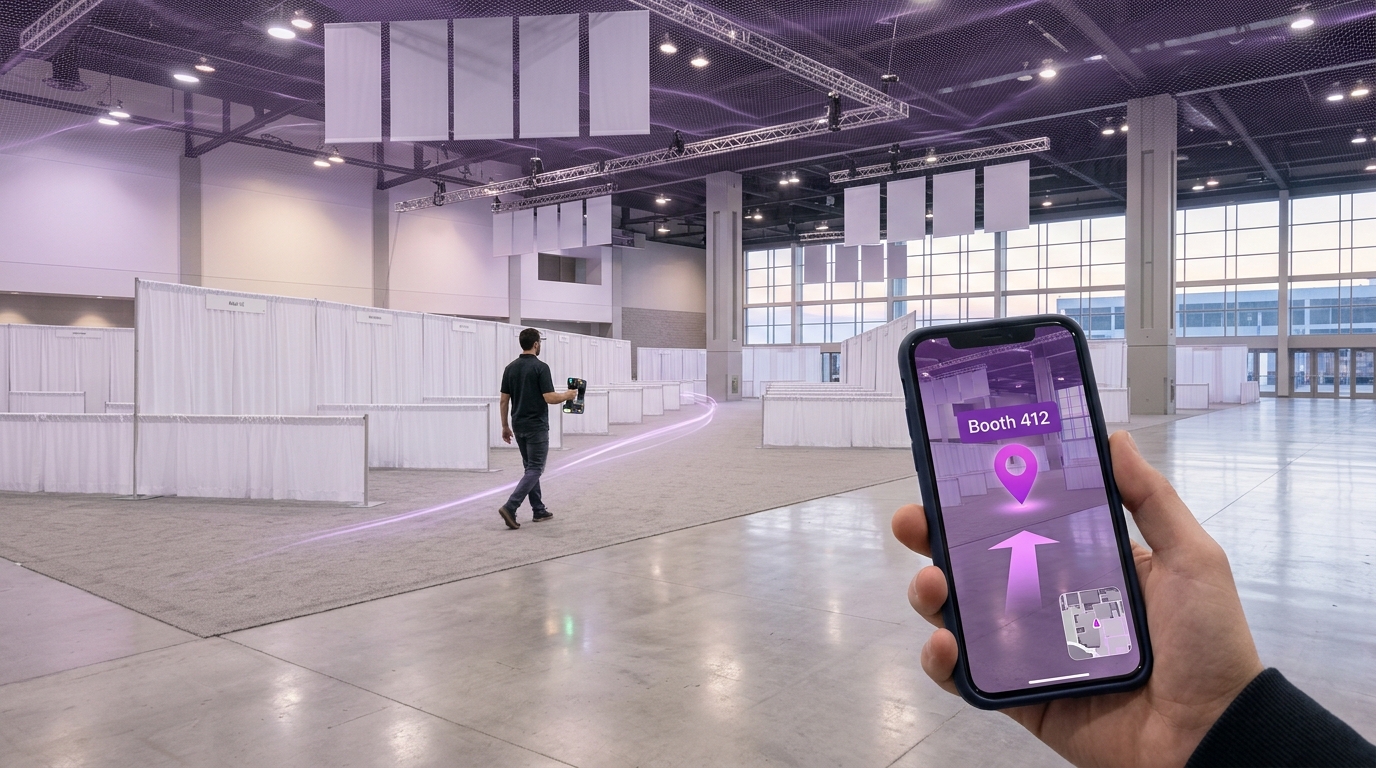
A single overnight shift. One scanner pass. No beacons, no Wi-Fi anchors, no custom app build. This is the production workflow a major North American venue used to turn an empty convention hall into a fully AR-navigable space before doors opened the next morning. MultiSet VPS is the localization engine. XGRIDS K1 handles capture. Zappar Spaces handles authoring. The result is centimeter-accurate indoor wayfinding on every attendee's phone, with no infrastructure left behind on the floor.
A navigation problem that signage cannot fix
Trade shows, conferences, and large-format events share the same recurring pain points around on-site navigation.
Attendees miss sessions and miss vendor booths because they cannot orient themselves quickly inside large halls.
Exhibitors lose meeting time coordinating with invited visitors. A prospect arrives at the venue, messages the booth owner, and both sides spend ten or fifteen minutes on calls and "meet me near the coffee station" handoffs before the actual conversation can begin.
Sponsor activations and stage placements are difficult to surface to attendees who do not already know they exist.
Accessibility routes are rarely communicated visually, leaving attendees with mobility needs to ask staff for directions.
The typical fix is an SDK-based custom mobile app with beacons or Wi-Fi fingerprinting. It takes weeks of engineering, requires hardware deployment, and is rarely accurate enough for confident turn-by-turn guidance indoors.
MultiSet VPS as the localization backbone
This workflow replaces a multi-week engineering project with a four-step, off-the-shelf pipeline. The scanner captures, MultiSet localizes, and the authoring tool decorates. Because MultiSet handles the hard part, sub-meter indoor positioning on commodity phones, the rest of the stack stays light.
Centimeter-level localization, no on-site hardware. MultiSet localizes attendee phones against the venue map using only the device camera — no Bluetooth beacons, no Wi-Fi RTT anchors, no QR-code wallpaper to install or maintain.
Hands-off map generation. From E57 input to a deployable VPS map and textured mesh in roughly 1.5 hours of unattended compute — the operator can step away while it runs.
Single source of truth for runtime + authoring. The same MultiSet output drives both phone-side localization and the Zappar Spaces authoring canvas, so what authors place is what attendees see — no coordinate drift between tools.
Map Versioning (rolling out). Re-open a base scan, edit and republish the POI layer without re-capturing the venue or re-running E57 conversion and VPS generation — collapsing the iteration loop on subsequent edits to roughly two and a half hours of focused work.
Open inputs, integration-friendly outputs. Standard E57 in, textured mesh out — interoperable with XGRIDS, other SLAM scanners, and authoring tools beyond Zappar.
Component
Role in the workflow
MultiSet VPScore
The Visual Positioning System at the heart of the stack. Ingests the scan, builds the localization map and textured mesh in roughly 1.5 hours of unattended compute, and serves on-device localization to attendee phones with centimeter-level accuracy. Map Versioning (rolling out) lets teams iterate the POI layer without re-scanning.
XGRIDS K1
Handheld SLAM scanner used to capture a high-fidelity 3D point cloud of the venue in a single walkthrough. Feeds MultiSet VPS via the open E57 format.
Zappar Spaces
No-code authoring platform that consumes the textured mesh produced by MultiSet VPS to place points of interest, signage, arrows, and 3D wayfinding cues aligned to the venue.
Event Floor Plan
The source of truth for booth numbers, room names, stage locations, and accessible routes. Used as a reference layer when authoring POIs on top of the VPS map.
One overnight shift, five steps
Timeline reflects a real deployment in a 25,000 sq ft venue, executed by a single trained operator. Larger venues scale scanning time linearly. The pipeline structure does not change.
#
Step
Time
What happens
1
Scan the site with XGRIDS K1
20 min
Walk the venue floor while the K1 captures a SLAM-based point cloud. One operator, no tripods, no targets.
2
Convert the scan to an E57 file
1.5 hrs
Process the raw scan into the open E57 standard so it can be ingested by downstream tools. Largely automated. Runs in the background.
3
Generate the VPS using MultiSet
1.5 hrs
Upload the E57 to MultiSet and trigger VPS generation. In about 1.5 hours of compute, MultiSet produces both the localization map (consumed by phones at runtime) and the textured mesh (consumed by Zappar Spaces for authoring). The linchpin step. Everything downstream depends on it, and it runs unattended so the operator can move on to floor-plan prep.
4
Author POIs in Zappar Spaces
2 hrs
Drop pins for booths, stages, restrooms, and emergency exits. Add arrows, labels, and 3D content along the routes attendees will actually walk.
5
Publish and test the AR navigation
30 min
Push the experience live, scan the QR or open the deep link on a phone, and validate localization accuracy and route clarity at key checkpoints.
Total wall-clock time
≈ 5 hrs 50 min
Start after the last vendor leaves. Finish before doors open.
Outcomes: What changed on show day
Centimeter-level localization on every attendee phone
MultiSet VPS locks devices to the venue map in seconds, with accuracy that supports turn-by-turn arrows painted on the floor.
Zero on-site infrastructure
Because MultiSet localizes from camera frames alone, there are no beacons to deploy, no anchors to maintain, and no QR-code wallpaper. Attendees open a link and start navigating.
Exhibitor-ready wayfinding
Booth owners share a deep link that drops invited visitors directly into AR navigation pointed at their booth. The "I'm here, where are you?" round-trip disappears.
Editable up to the last minute
If a booth moves at 7am, an organizer drags the POI in Zappar Spaces against the existing MultiSet map and republishes. No app store cycle.
Iterable POI layer with Map Versioning
Each show still needs a fresh scan, because the same hall looks visually different once booths, drape, and signage are in place. But Map Versioning lets the base scan be re-opened to edit and republish the POI layer without redoing capture.
Map Versioning: one scan, many shows
Map Versioning treats the MultiSet VPS map as a living asset rather than a one-shot artifact. Once a venue has been scanned and a base map has been published, organizers can re-open that map, edit the POI layer on top of it, and republish, without re-capturing the venue, re-running E57 conversion, or re-running VPS generation. The localization geometry stays exactly as it was. Only the content layer changes.
In practice, this turns the most expensive parts of the original overnight pipeline into one-time costs amortized across every subsequent show, refresh, or last-minute floor change. What remains is the work that actually changes between events: dropping pins, updating signage, validating routes.
From ~6 hours to ~2.5 hours on recurring venues. By skipping scan, conversion, and VPS generation, the on-site critical path collapses from roughly five hours and fifty minutes to roughly two and a half hours of focused authoring and validation.
Same-day, in-place edits. If a booth moves at 7am or a sponsor activation is added the morning of, organizers republish the POI layer in minutes against the existing map — no rescan, no recompile, no app store cycle.
Versioned, rollback-safe POI layers. Each republish is a discrete version, so an organizer can preview a new POI set, ship it for the morning rush, and roll back to a previous version if something looks wrong — without touching the underlying VPS map.
One scan, many shows. For convention centers and venues that host repeat events, a single base scan can serve as the localization foundation across the entire show calendar, with each event published as its own POI version on top of the same MultiSet map.
Join industry leaders in changing the way you build spatial computing solutions and scale your deployments.