Spatial Intelligence

The convergence of artificial intelligence and spatial computing is creating unprecedented opportunities for innovation. At the forefront of this transformation is https://www.multiset.ai/vps, a groundbreaking technology that enables AI agents to understand and navigate physical spaces with remarkable precision. This blog explores how AI agents can leverage MultiSet VPS APIs for enhanced spatial reasoning and examines the transformative potential across multiple industries.

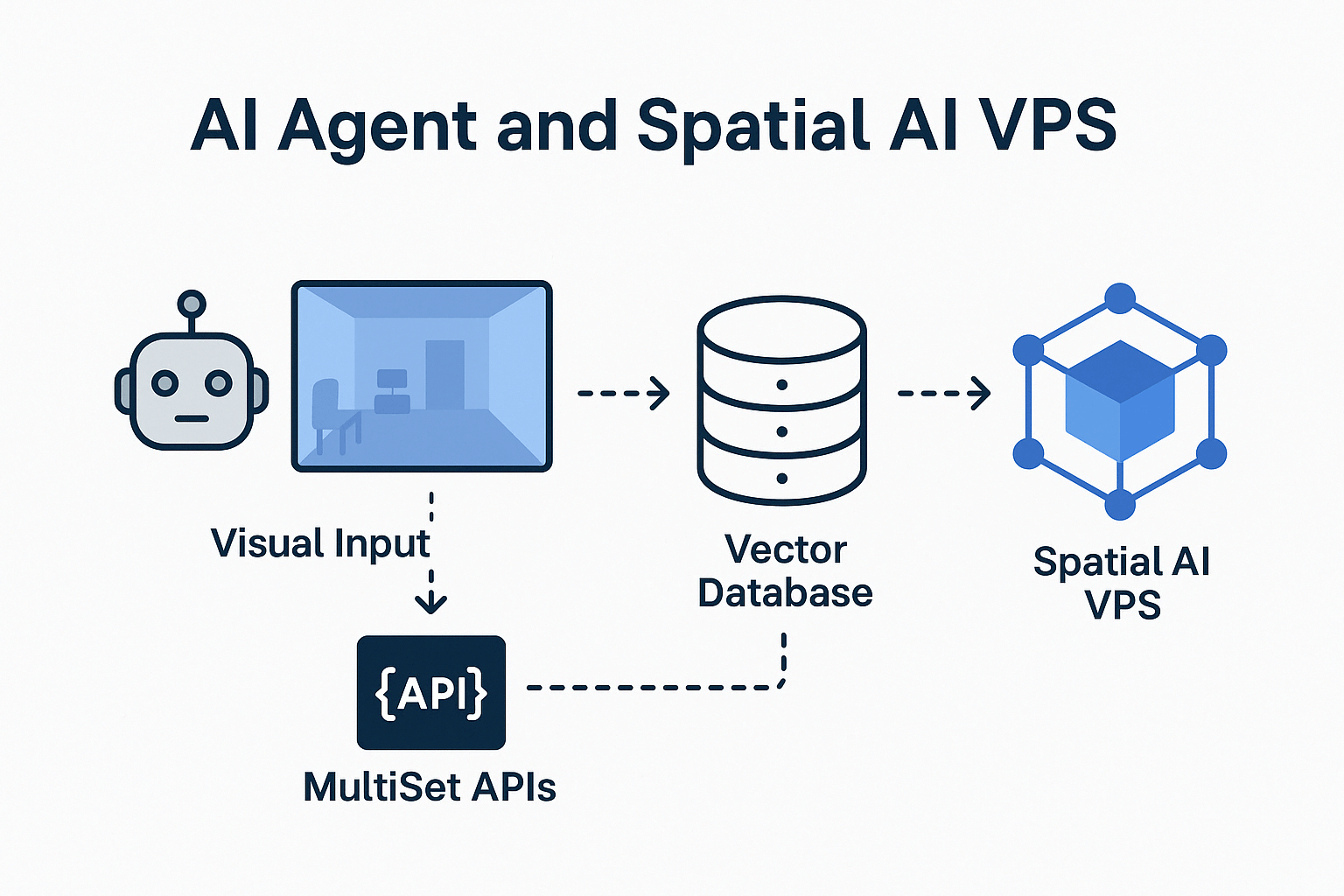
MultiSet VPS is an AI-based system that transforms complex spatial data, such as LiDAR scans, into queryable vector representations. This revolutionary approach allows for efficient visual localization, enabling AI systems to understand precisely where they are in physical space and how to navigate through it.
The core innovation lies in how MultiSet VPS converts high-dimensional spatial information into vector embeddings—mathematical representations that capture the essence of physical environments in a format AI systems can efficiently process. When an AI agent needs to determine its position, it can query these vector databases to rapidly match current visual input against stored spatial data.
Spatial intelligence represents a significant evolution in AI capabilities. While traditional AI systems excel at processing text, images, and structured data, spatial reasoning introduces a new dimension of understanding that closely mirrors human perception of physical environments.
When AI agents integrate with MultiSet VPS, they gain several critical capabilities:
Integrating with MultiSet VPS APIs involves several key processes:
This technical foundation empowers AI developers to create systems that truly understand physical spaces, bridging the gap between digital intelligence and real-world navigation.
The integration of AI agents with MultiSet VPS is creating new possibilities across numerous sectors:
Manufacturing facilities are deploying autonomous robots that navigate complex factory floors with unprecedented accuracy. These robots use MultiSet VPS to understand their position relative to machinery, inventory, and human workers, enabling safer and more efficient operations.
A leading automotive manufacturer recently implemented this technology, resulting in a 28% increase in warehouse operational efficiency and a significant reduction in navigation errors.
Retail environments are being transformed through AI agents that assist customers in finding products with pinpoint accuracy. These systems understand store layouts at a granular level and can guide shoppers directly to items, even as store configurations change over time.
Major retailers report increased customer satisfaction and reduced abandoned searches when implementing these spatially aware AI assistants.
AI agents equipped with spatial intelligence are revolutionizing construction management by comparing real-world progress against digital building plans. This allows for early detection of construction errors and more accurate project timelines.
Architecture firms use these capabilities to visualize design changes in existing spaces, helping clients better understand proposed modifications through augmented reality interfaces powered by precise spatial positioning.
Hospitals are implementing navigation systems that help patients find their way through complex medical facilities. For individuals with visual impairments, AI agents using MultiSet VPS can provide detailed guidance through unfamiliar environments, describing surroundings and identifying obstacles with remarkable precision.
Entertainment venues are creating immersive AR experiences where digital content is anchored precisely to physical locations. This enables shared augmented reality experiences where multiple users can interact with the same virtual objects positioned in real space.
As MultiSet VPS technology continues to evolve, we can anticipate several exciting developments:
The integration of MultiSet VPS with AI agents represents a significant leap forward in how digital systems understand and interact with physical reality. This technology enables entirely new categories of solutions that were previously impossible without sophisticated spatial reasoning.
As spatial intelligence becomes a standard capability for advanced AI systems, we can expect increasingly seamless integration between digital intelligence and the physical world.